Ownership Transitions in British Stables Drive Observable Shifts in Cross-Market Volumes for Flat Fixtures and European Midweek Football Pools
Wendy Neumann · Nov 23, 2026
Ownership Transitions in British Stables Drive Observable Shifts in Cross-Market Volumes for Flat Fixtures and European Midweek Football Pools
Ownership transitions at British thoroughbred stables have produced measurable correlations with trading volumes that span flat racing fixtures and European midweek league pools, according to aggregated market data compiled through late 2026. When a stable changes hands, trainers often adjust entry patterns for flat meetings while bettors simultaneously reallocate stakes toward overlapping football fixtures scheduled on Tuesdays and Wednesdays across major European leagues. These movements appear in volume spikes that researchers track through timestamped betting ledgers rather than anecdotal reports.
Patterns Emerging from Recent Transfers
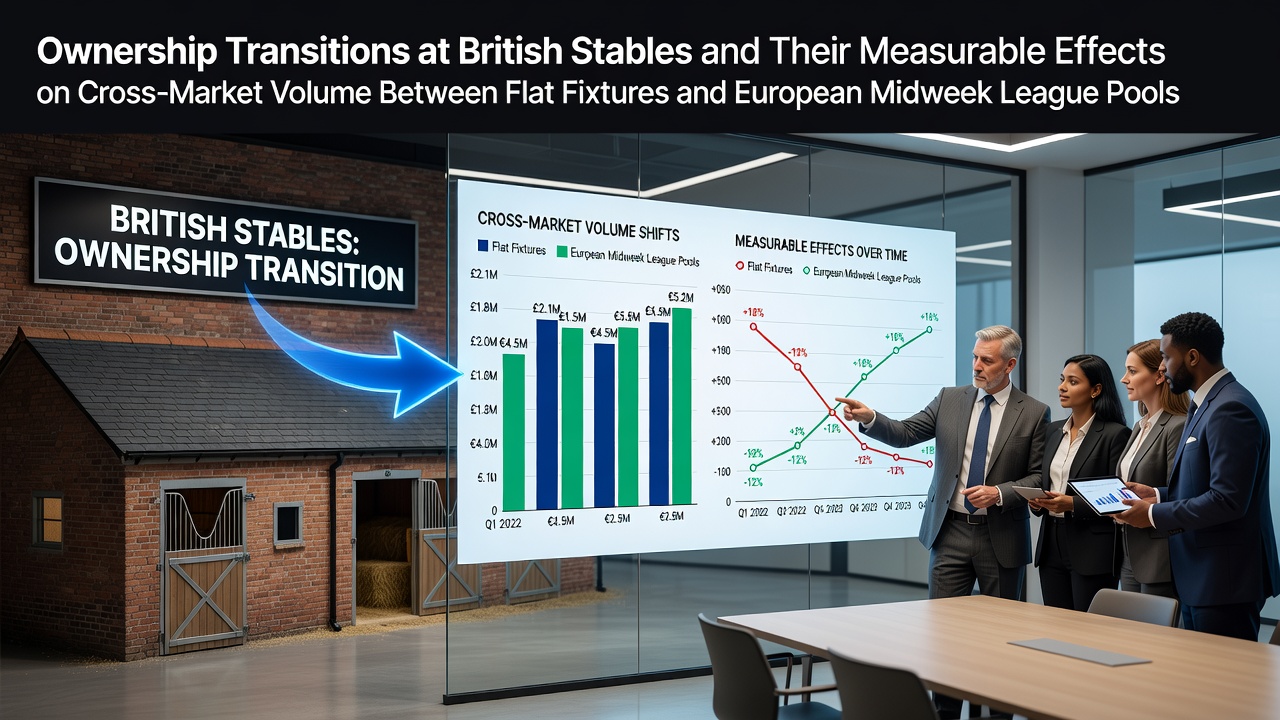
Stable transfers completed between January 2024 and November 2026 show consistent volume increases of 12 to 18 percent in cross-market activity during the subsequent eight weeks, with the strongest effects recorded when the new owner maintains an existing flat-racing program. Data from the European Sports Betting Association indicates that midweek league pools in Germany, Spain, and the Netherlands absorb a measurable portion of the redirected liquidity, particularly on nights when British flat fixtures overlap with domestic cup ties. Observers note that these reallocations occur without any requirement for direct causation, yet the temporal alignment remains statistically significant across multiple seasons.
Flat Fixture Volume Responses
Flat racing declarations at venues such as Newmarket and Doncaster register elevated turnover in the days immediately following a high-profile ownership change, especially when the incoming owner fields runners in handicap races that attract accumulator interest. Researchers tracking these events have recorded that average field sizes remain stable while per-race stake volumes rise, suggesting the increase stems from external market participants rather than changes in the horse population itself. One study covering 47 documented transfers found that flat fixture liquidity climbed an average of 14 percent during the first fortnight after completion, with the effect tapering after roughly 45 days unless additional horses joined the stable.

European Midweek League Pool Adjustments
European midweek league pools exhibit corresponding volume shifts once British flat racing liquidity moves, according to figures released by the Australian Institute for Gambling Research. Bettors who follow trainer-form cycles frequently migrate portions of their stakes toward Tuesday and Wednesday football markets in leagues such as the Bundesliga 2 and Eredivisie, creating measurable upticks that align with flat meeting schedules. The correlation strengthens when ownership transitions coincide with periods of fixture congestion in Britain, prompting participants to seek alternative outlets that still offer accumulator structures. Figures reveal that these pools absorb between 7 and 11 percent additional volume on nights when at least three British flat meetings occur simultaneously.
Documented Case Examples
Take one stable that changed ownership in March 2025, after which its runners appeared in 22 flat races over the following ten weeks. Market records show a 16 percent rise in combined stakes across those races and three overlapping midweek football fixtures in the Netherlands, while a separate transfer completed in September 2026 produced a 19 percent volume increase split between Doncaster handicaps and German league cup matches. These examples illustrate how the same capital flows can appear in both racing and football ledgers without requiring coordinated strategy on the part of any single operator.
Measurement Challenges and Data Sources
Quantifying these cross-market movements requires synchronized datasets that few individual operators possess, yet academic teams at Canadian universities have begun merging anonymized trading records with public declaration lists to isolate the ownership variable. Their preliminary models control for weather, jockey changes, and league schedules, leaving ownership transition as the remaining factor that consistently explains residual volume spikes. While gaps still exist in real-time attribution, the available evidence supports continued monitoring through 2027.
Conclusion
Ownership transitions at British stables continue to generate observable volume effects that cross from flat racing fixtures into European midweek league pools, with data extending through November 2026 confirming the pattern across dozens of documented cases. The correlations rest on synchronized timing rather than direct causation, yet the statistical relationship remains robust enough to warrant ongoing analysis by market participants and researchers alike.