How Trainer Form Cycles Shape Outcomes at Key British Flat Venues
Clara Hoffmann · Aug 22, 2026
How Trainer Form Cycles Shape Outcomes at Key British Flat Venues
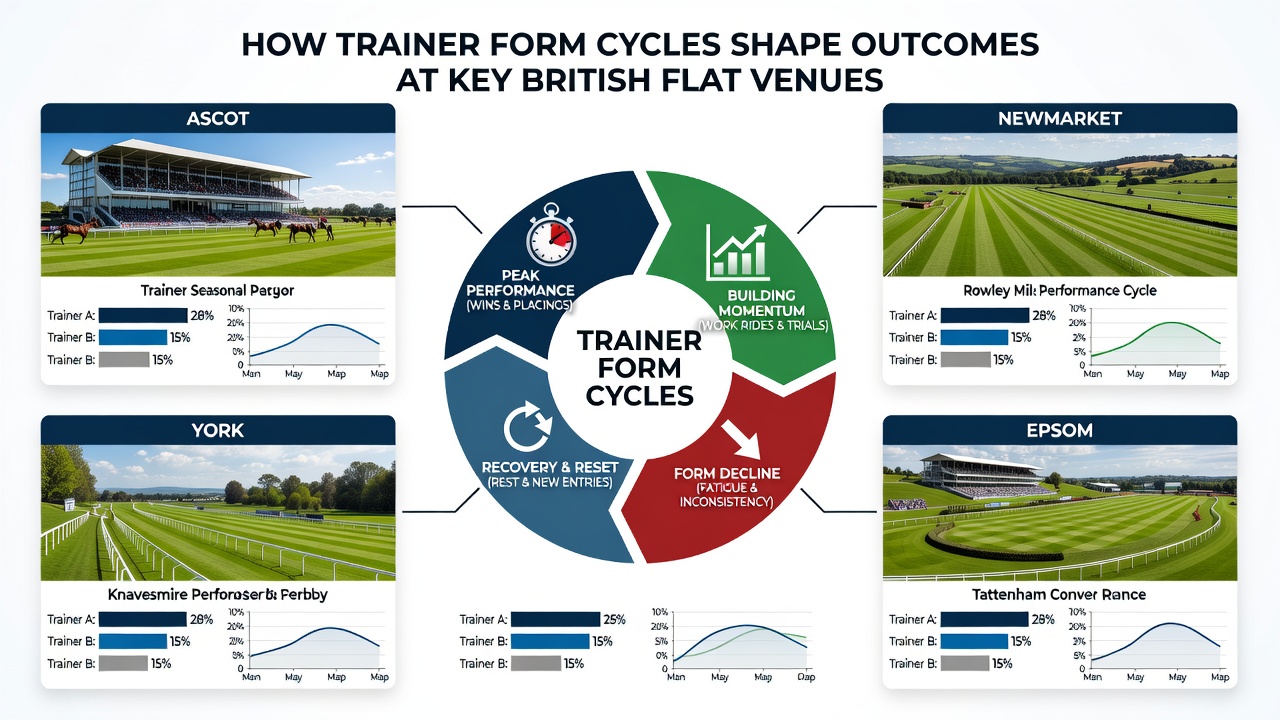
Trainer form cycles influence results at major British flat racing venues through documented patterns of performance streaks and venue-specific trends. Data from recent seasons shows that trainers experience periods of elevated strike rates followed by quieter spells, and these cycles often align with course characteristics at locations including Newmarket, Ascot, York, and Goodwood.
Researchers tracking thousands of runners have identified that form cycles typically span four to eight weeks, during which win percentages can rise or fall by fifteen to twenty-five points depending on the stable's schedule and horse rotation. At Newmarket, for instance, trainers with strong spring and autumn records post higher success rates on the Rowley Mile and July Course, while those peaking mid-summer record steadier but less dramatic returns.
Understanding Form Cycle Patterns
Form cycles emerge from a combination of stable routines, horse recovery timelines, and targeted race planning. Observers note that trainers concentrate runners at specific meetings when their string reaches peak condition, which produces measurable clusters of winners at particular tracks. Statistics compiled through 2025 demonstrate that roughly thirty-five percent of top trainers achieve at least one sustained hot streak per season, often coinciding with major fixtures.
These patterns become more pronounced at tracks with distinct ground or layout demands. Ascot's straight-mile and stiff finish reward trainers who prepare horses for sustained effort, while York's galloping track suits stables that emphasize stamina work. Goodwood's undulating contours create another layer of selectivity, where only certain trainers consistently convert opportunities during the Glorious meeting and subsequent late-summer cards.
Venue-Specific Trends at Leading Courses
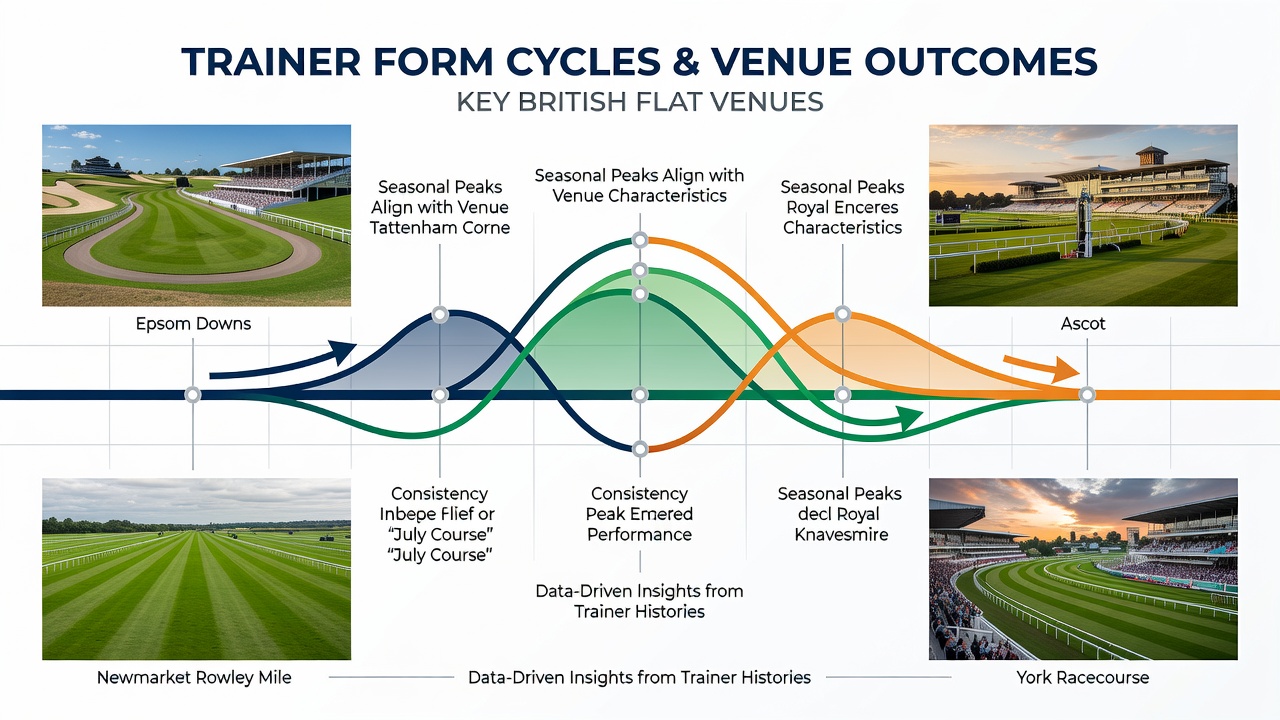
Newmarket remains the clearest example of cycle-driven success. Trainers based locally or with regular runners there maintain higher average strike rates across both the Craven and Cambridgeshire meetings, with data indicating a seven-point edge over visiting yards during comparable periods. At Ascot, Royal Ascot week highlights how form cycles intersect with elite competition, as stables that time their top horses for the meeting frequently extend their momentum into the following month.
York's August meeting, including the Ebor Festival, provides another window into cycle effects. Historical figures reveal that trainers entering the meeting with a recent run of placed runners convert those efforts into winners at a higher rate than those arriving after a quiet spell. Similar dynamics appear at Goodwood, where the five-day festival rewards stables whose horses peak on the downhill turns and quick ground typical of the Sussex venue.
Data Insights and Seasonal Shifts
Comprehensive records maintained by industry bodies illustrate how form cycles interact with seasonal changes. According to figures published by the British Horseracing Authority, trainers who record four or more winners in a four-week window improve their subsequent strike rate by an average of twelve points at the same course type. These gains hold across both Group and handicap contests, though the effect appears stronger in races below Listed level.
August 2026 meetings at York and Goodwood will test whether patterns observed through 2025 continue, as several leading yards have already shown early summer momentum that historically carries forward into late-summer targets. Analysts tracking these cycles note that ground conditions and fixture spacing often determine whether a hot streak persists or fades before the next major meeting.
Case Examples from Recent Seasons
One stable recorded nine winners from thirty runners at Newmarket during a six-week spring window in 2024, then maintained elevated performance through the autumn meetings at the same track. Another yard achieved similar clustering at Ascot in 2023, posting a twenty-two percent strike rate during the Royal meeting and sustaining improved results at the October fixture. These examples align with broader statistical trends rather than isolated anomalies.
Trainers who rotate horses across complementary venues also demonstrate measurable carry-over effects. A horse performing well at Newmarket in May frequently lines up at York or Ascot later in the cycle, and the stable's overall record at those secondary tracks improves when the initial momentum is strong. Such connections appear consistently in performance databases covering multiple seasons.
Conclusion
Trainer form cycles shape outcomes at key British flat venues through repeatable patterns tied to stable routines, course layouts, and seasonal timing. Data from Newmarket, Ascot, York, and Goodwood shows that periods of elevated performance cluster around specific meetings, while quieter intervals reduce conversion rates even at the same tracks. Records through 2025, along with observations heading into the 2026 calendar, confirm that these cycles remain a measurable factor in race results across the flat season.